
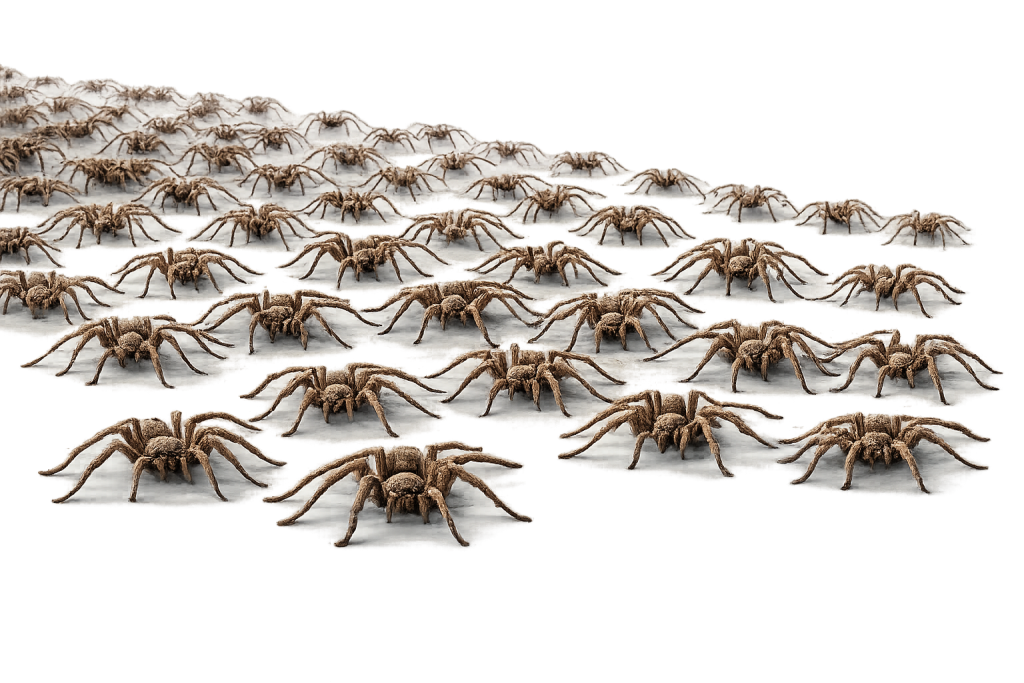
Spiders Around Your Home: Identification, Risks, Prevention
Know what attracts spiders, where they hide, and the practical steps that reduce activity fast—plus when professional treatment is the smarter move.
Spiders Don’t Show Up by Accident
- Spiders follow food sources (other insects)
- If you see spiders, there is already an underlying pest issue
- Web removal does nothing to stop activity
- DIY sprays rarely reach where spiders hide
Common Spiders Found Inside Homes
House spiders vary widely in size, color and behavior. Many appear more often in autumn when males leave their webs in search of females. Below are nine types of house spiders commonly found indoors, including the often-searched grey house spider.
 Grey house spider (Badumna longinqua)
Grey house spider (Badumna longinqua)
ID cue: Mottled grey to charcoal, often near a thick, messy-looking retreat
Where: Around window trim, under eaves, sheds, dry corners
Risk note: Harmless, avoids people
Brown house spider or False widow (Steatoda grossa)
ID cue: Dark brown with a rounded abdomen, often mistaken for a widow
Where: Garages, basements, storage corners, undisturbed indoor areas
Risk note: Low concern, bites can cause mild discomfort
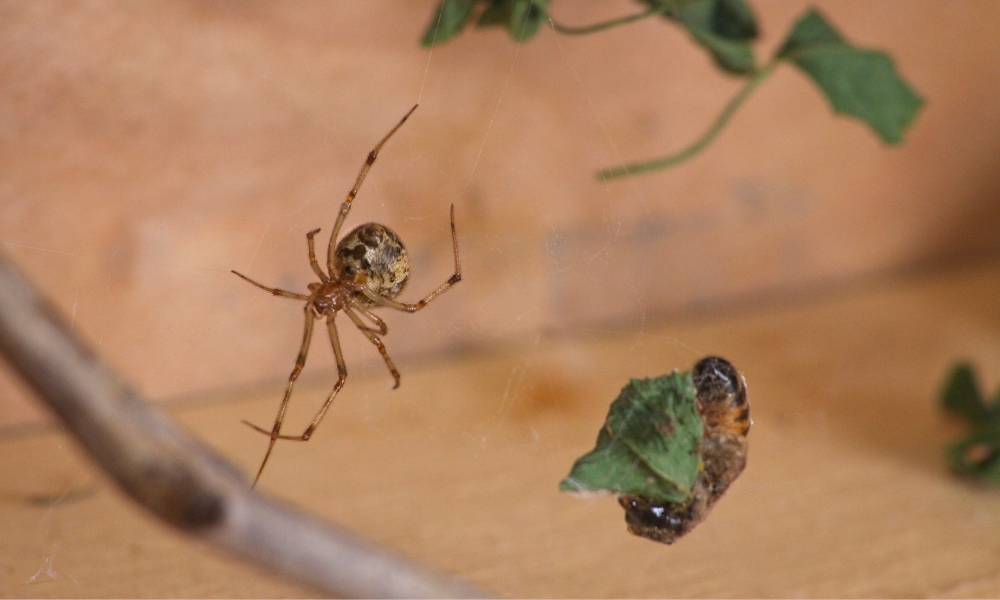 American house spider (Parasteatoda tepidariorum)
American house spider (Parasteatoda tepidariorum)
ID cue: Small brown to grey cobweb spider with tangled webs
Where: Ceiling corners, windows, vents, quiet junctions
Risk note: Harmless, helpful for flying insects
Cellar spider (Pholcus phalangioides)
ID cue: Very long thin legs, small pale body, hangs in loose webs
Where: Basements, garages, crawlspaces, ceiling corners
Risk note: Harmless, may “vibrate” when disturbed
 Barn funnel weaver (Tegenaria domestica)
Domestic house spider or Barn funnel weaver (Tegenaria domestica)
ID cue: Brown and fast, funnel-shaped web retreat
Where: Basements, utility rooms, baseboards, cluttered storage areas
Risk note: Harmless, usually flees
Giant house spider (Eratigena atrica)
ID cue: Large, brown, long-legged, fast runner
Where: Garages, basements, lower levels, wanders indoors
Risk note: Harmless, bites are rare
Hobo spider (Eratigena agrestis)
ID cue: Brown with subtle chevrons, funnel-web builder
Where: Ground level areas, basements, along foundations
Risk note: Generally considered medically insignificant
 Southern house spider (Kukulcania hibernalis)
Southern house spider (Kukulcania hibernalis)
ID cue: Males light and roaming, females darker and tucked in retreats
Where: Windows, attics, door frames, exterior-adjacent corners
Risk note: Low concern, shy and non-aggressive
Yellow sac spider (Chiracanthium inclusum)
ID cue: Pale yellow to tan, slender, often seen roaming at night
Where: Walls, ceilings, upper corners, behind frames
Risk note: Can cause mild irritation if trapped against skin
How to identify which spiders are in your home
Trying to identify a house spider can feel overwhelming, especially when you are staring at a small grey spider in a corner and wondering what it is. These four steps will help you narrow it down without needing to be an expert.
1. Check the web type. Does your spider make a messy cobweb, a funnel web or no web at all?
- Messy cobweb → Often an American house spider or brown house spider (commonly in corners and around windows)
- Funnel web → Could be a domestic house spider or hobo spider (often near ground level, in basements or along foundations)
- No obvious web → Often a yellow sac spider or another wandering hunter that roams walls and ceilings at night
2. Look at the leg-to-body proportion. Are the legs noticeably long compared to the body?
- Very long, thin legs → Common in cellar spiders (sometimes called “daddy longlegs”), which are often found in basements and garages
- Legs more proportionate and sturdy → Could be a domestic house spider, giant house spider or grey house spider, which tend to have thicker legs and stockier bodies

3. Examine color and markings. Do you see any distinctive shapes or patterns?
- Violin-shaped marking on the back → May indicate a brown recluse. This species can cause medically significant bites and deserves caution
- Red hourglass on the underside of the abdomen → Characteristic of black widow spiders, another species that should be treated with care
- No distinct markings, just brown or grey → More likely a common house spider, grey house spider or hobo spider, most of which are considered non-aggressive and avoid contact
4. Note where you found it. Location offers useful clues:
- Basement or dark, damp area → Often a cellar spider or domestic house spider
- Ceiling or upper wall corners → Common for yellow sac spiders and American house spiders
- Near windows, doors or quiet crevices → Frequently where southern house spiders and grey house spiders build retreats and wait for insect prey
These simple checks will not make you an arachnologist, but they can help you move from “mystery grey spider” to a likely identification and a clearer sense of whether the spider is harmless and best left alone or better managed with a calm, targeted response.
Spiders that deserve extra caution
These are the two medically significant spiders to know if you want to be cautious about identification, plus one spider that is commonly misidentified.
Though most house spiders are harmless and stay out of sight, it helps to recognize the few that deserve extra caution. These spiders are not aggressive, but black widows and recluse spiders can cause medically significant bites if they are pressed against skin. If you’re ever unsure, avoid handling any spider directly.
Brown recluse (Loxosceles reclusa)
A medium-brown spider with a distinct violin-shaped marking on its back. Brown recluses prefer warm, undisturbed areas like closets, sheds and woodpiles. They rarely seek out interaction, but their bites can cause localized reactions that require medical attention. If you suspect you’ve found one, give it space and avoid direct contact.

Black widow (Latrodectus)
Easily recognized by its shiny black body and red hourglass on the underside of the abdomen. Black widows tend to hide in sheltered places such as garages, woodpiles and outdoor storage. They are shy and only bite when pressed or threatened, but their venom can cause significant discomfort. Careful avoidance is the safest approach.
Hobo spider (Eratigena agrestis)—commonly misidentified
The hobo spider is often confused with more concerning spiders. While it was once believed to cause serious bites, current evidence suggests hobo spider bites are typically not medically significant. They build funnel-shaped webs near ground level and tend to avoid people, but their fast movement often leads to misidentification.
Black widows and brown recluses are the exception, not the rule. Most indoor spiders, including the grey house spider, cellar spiders and American house spiders, are timid, beneficial and part of a natural pest-control balance inside the home.
Spider lifespan: How long do common house spiders live?
Spider lifespans vary widely depending on species, environment and sex. Many common house spiders live for one to two years, but some can survive far longer when they remain undisturbed in steady indoor conditions.
In general, female spiders outlive males. This is partly due to biology: females continue building retreats, catching prey and producing egg sacs throughout their lives, while males often have one goal—mature, mate and decline soon after. In some species, males do not survive long past reproduction. In others, males may even be consumed by the female, a strategy that provides additional nutrients and may contribute to the female’s extended lifespan.
Here are a few examples that help put their longevity in perspective:

- American house spider (Parasteatoda tepidariorum): Lives for about one year, though sheltered indoor spaces can extend that.
- Grey house spider (Badumna longinqua): Typically lives around one year, with some females lasting longer in quiet corners and undisturbed retreats.
- Barn funnel weaver (Tegenaria domestica): Can live up to seven years, especially when left alone in basements or storage areas.
- Black widow (Latrodectus): Females may live up to three years; males usually live one season.
- Tarantulas (Theraphosidae): Among the longest-lived spiders—some species reach 10 to 30 years.
- Wolf spiders (Lycosidae): Males often live less than a year, while females may survive several seasons.
- Trapdoor spider (Ctenizidae): Exceptional outliers: the oldest recorded individual reached 43 years.
Fun fact: In one species, Thanatus fabricii (which does not have a common name), males have been observed biting and gently restraining females with silk before mating. Researchers believe this unusual behavior helps the male avoid being eaten afterward.

How to get rid of spiders in the home
If you prefer fewer spiders inside, a steady, simple routine works better than one-time fixes. Most spiders come indoors while following insect prey, so reducing food sources and closing off entry points can make a noticeable difference. The support of a professional
1. Remove what attracts insects

Spiders settle where prey is easy to find. Reducing indoor insect activity lowers the odds they stick around.
- Keep counters clear of crumbs
- Store food in sealed containers
- Address fruit flies quickly
- Empty indoor trash more often in warmer months
A home with fewer insects naturally becomes less interesting to spiders.
2. Declutter and reduce hiding places
Spiders prefer quiet, undisturbed spaces. Tidying storage areas, shaking out infrequently used linens and clearing piles of boxes removes many of the spots where spiders build retreats.
- Basements and garages
- Closets and storage shelves
- Behind furniture
- Window ledges and eaves
A little movement and airflow go a long way toward discouraging spider retreats.
3. Seal small gaps and entry points
Simple fixes help keep insects and spiders from entering.
- Repair torn screens
- Seal gaps around windows and doors
- Check weather stripping
- Use door sweeps where needed
These steps limit drafts and tiny openings that spiders follow indoors.
4. Call a Professional
When the issue starts to get overwhelming or you know you hate spiders and want to get ahead of the potential problem. Call PestLogic and let us ease your mind controlling the spiders for you.